
What if you had amnesia?
The Therapeutic Gift of Forgetting


Whilst conducting research for my MSc Psychology dissertation on peoples’ perceptions of aging, one interviewee spoke of her mother who had become a happier and calmer person despite the ravages of dementia. Released from the long-held grip of severe depression, and unable to remember much of her previous life, she became locked in the present moment allowing her to revel in everyday joys - the smell of a rose in her garden, the taste of a juicy pear, the play of sunlight across the bedroom wall. It was as if she had forgotten all the reasons to be unhappy.
Clearly suffering from dementia, or an associated condition resulting in memory loss, has few upsides. Without the ability to remember, sufferers are barely able to function as memory is integral to our lives, allowing us to track conversations, recall our payment card PIN, perform well in exams, recognise people’s faces, understand what we are reading, remember to keep a future appointment at the dentists, and so on. Even our sense of self would be lost if we lacked memory of our own personal history.
Medical issues aside though, even when our brain is functioning at optimum capacity, we do not remember every moment. We have limited capacity to store everything in an easily retrievable form and forgetting is therefore a crucial part of memory management, helping us to prioritise and consolidate important information. Due to this process of pruning, our memories may not always be as reliable as we presume and can play tricks on us. Memories do not remain consistent, as each replay of a memory rewrites it, with parts deleted, and sometimes added. Karim Nader’s research has shown that memories are not something filed away in a filing cabinet for future use but are rebuilt from proteins in the brain every time we recall something, making then vulnerable to disruption1. As author Jo Harkin describes ‘Memory isn’t written in stone: it’s more like a photocopy of a photocopy.’2 We may become aware of this when trying to recollect people who are no longer with us.
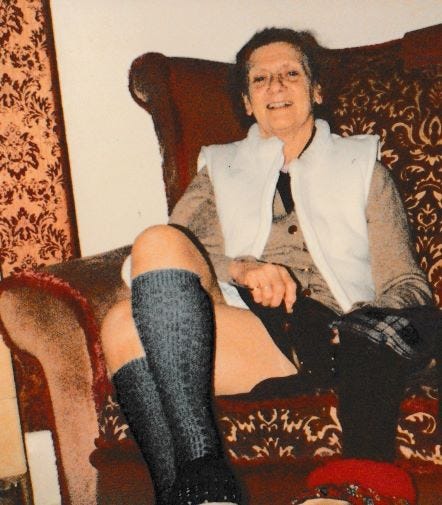
I hold a mental image of my grandma smartly dressed but wearing slippers, tucked in her habitual spot on the end of a red, patterned Dralon settee, laughing, possibly at the game we had just played, which resulted in me squirting milk out of my mouth all over her. This memory I now know is an amalgamation of many moments mixed with an old photograph; a kind of grandma-related collage. When sorting through old albums I chanced upon the photo that my memory had been built around and found that I had not only deleted my sister from the picture but also, had not remembered how sad and tired my grandma looked. The photo had been taken only a few short months before she took her own life - we often choose what to remember, change, or forget.
Forgetting is not only an individual pursuit. Collectively we can rewrite the past, especially if it serves a preferred narrative. History is written by the victors after all. Old photographs and video clips are often circulated on social media harking back to more halcyon times, claiming it was when there was ‘less crime’ and ‘everything was better’. Tellingly, these memes ignore the painful parts of the past, with the realities of abject poverty, or a country in the middle of war, forgotten. My own 1970s childhood growing up on a farm was, in many ways idyllic, but it also played out against a backdrop of strikes, power cuts, the Cold War, IRA bombings, high inflation, slow economic growth, and industrial decline. These cultural and political challenges are easy to forget, or twist nostalgically in our desire to reclaim childhood fantasies.
It did get me thinking though that if forgetting is so important to how we function and we do it anyway, can we use it proactively to decide what to remind ourselves of and, what to choose to forget? Whilst deletion, or ‘motivated forgetting’3, of traumatic or emotional memories can be a defence mechanism against trauma and certainly not always helpful, what I am thinking about here is choosing to not remember those sneaky memories which we replay over and over, almost subconsciously, preventing us from completing important projects or moving forward with our dreams. The ones full of emotion that remind us of times when we did not perform at our best. The embarrassment of confusing one cousin’s husband with another. The work meeting in which you cried. The cutting feedback on your essay by an English teacher. These memories may only pop up as fleeting thoughts, but they can hold power over us. They can waylay us or totally crush our self-belief. The memory itself may be small. The effect far reaching.
As I have previously written, I am frequently poked by self-doubt, especially when writing, so I decided to experiment a little and record the thoughts that arose as I tried to go about my daily business. Unsurprisingly, there were many, but they followed very similar themes and when I drilled down, I could see how they were linked to only a handful of real moments from my past. A couple of these memories were major life events, but most were small vignettes that I had attached great significance to; a hurtful passing comment or when I had decided that I had failed in some way. These memories arrive laden with emotions and thoughts that, over time, have formed deep beliefs about what I am (and am not) capable of. They often stop me in my tracks, and I begin questioning myself. Layer upon layer of thoughts and emotion flood my body:
‘I’ve failed before, and it felt awful.’ Panic.
‘What if this thing I’m working on turns out the same way?’ Fear.
‘I’ll look stupid.’ Embarrassment.
‘What will people think about me?’ Shame.
Then the cascade of pernicious thoughts starts in earnest.
‘I’m no good at anything. ‘
‘I am not as qualified to do this as other people. ‘
‘When I get praise, it is only because they feel sorry for me. ‘
‘Everyone else can do this but not me. ‘
I am a failure.
This feeling of failure is at the root of it all and it is spirit breaking.
We all slip into habitual – thought - memory - belief loops, from time to time. Some are useful but many, like the one described above, are not. The brain craves certainty and easily falls into these thought patterns to both save us time in making decisions but, more insidiously, in its desperate attempt to maintain congruity with our self-image. For example, if you have always believed that you are unlovable your brain will cling to this belief no matter how painful or damaging because it seems safe, predictable, and true. You no doubt will have collected evidence over the years to bolster this belief too; your brain is not going to relinquish it easily.
But what if we didn’t have these thoughts or the memories that underpin them? What if we could start with a blank sheet? What if we could erase all the bad memories that slow us down?
What if we had amnesia?

Life coach, author, and podcaster Kara Loewentheil suggests that pretending to have amnesia can be a powerful reframing exercise, dragging us out of these negative belief cycles. She says, ‘this technique is really powerful when it comes to disclaiming our accomplishments or always looking for what we've done wrong or should be doing more of, because it erases the baseline that we're always comparing ourselves against negatively’.
This is not about looking at the world through rose-tinted spectacles, thinking we are perfect in every way, but it is a way to start from a neutral position. By pretending that none of our previous experiences have happened to us, it is as if we are embarking on things for the first time, with a beginner’s mind. No expectations. No pre-conceived ideas of our abilities. No derailing negative beliefs.
For example, if every time you think about changing your job, you remember your last work appraisal and how your line manager criticised you, you might fall into thoughts like ‘My manager told me I was not good at handling challenging situations with a difficult work colleague’, ‘they called me reactive’, ‘I find team dynamics stressful’, ‘any where I move to will be the same’, ‘my line manager will not give a good reference anyway’, ‘there is no point in looking for other work’.
As a result, you stay stuck in a dissatisfying job, the personality clash with the colleague making you increasingly miserable and not performing to the best of your ability. Whereas, if you woke up with amnesia, not aware of the poor appraisal score, you might see the situation more objectively. You are no longer happy in your current role and working with this person is unpleasant, therefore you just focus all your energy on hunting for a more suitable position and a new challenge.
After trying this for a while, I have found how useful a technique it is. Whilst not removing every bit of negative self-talk, it certainly moves my critical voice into the background. It allows me to focus on what I am working on, without distraction or comparison. In practice, it can simply look like me saying to myself, ‘today I am not remembering that thing that happened to me’. Just moving the memory out of view is enough. As well as dialling down the negativity it also gives me the freedom to approach each task with fresh eyes, by asking ‘if I had never done this before, what would I do?’
It will be interesting to see over time whether these persistent negative memories continue to slow me down or as I collect evidence to the contrary they fade, or even totally disappear.
It has shown me how forgetting, often framed as a flaw, holds power and used productively can confer great benefits.
Perhaps the greatest gift we can give ourselves, is to forget.
What memories could you benefit from forgetting, even if just for a little while, allowing you to move forward in your life or work?
“Just moving the memory out of view is enough. As well as dialling down the negativity it also gives me the freedom to approach each task with fresh eyes, by asking ‘if I had never done this before, what would I do?’” Yes! What a wonderful process to use to help us truly start fresh… also might be good to try not just on ourselves but with others in our lives 💝 thank you for sharing!
This is fascinating, thank you 🩵